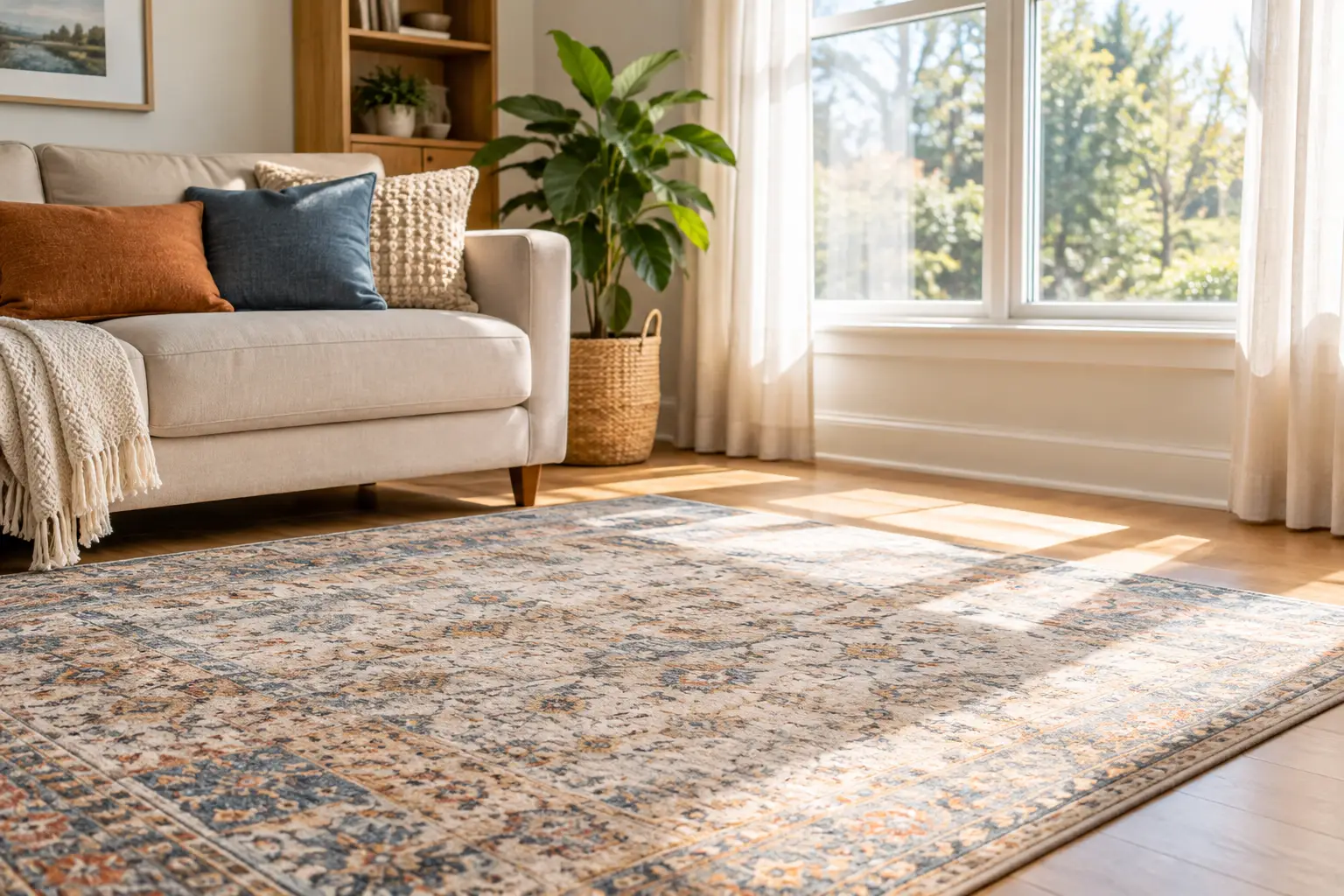
A 12-by-14 living room has enough space to feel generous, but it is also large enough to expose a rug that is too small. If you are asking, “what size rug should I buy for a 12×14 living room?” the short answer is usually an 8×10 or 9×12 rug. The better answer depends on how your seating is arranged, where the room opens into adjoining spaces, and how much of the floor you want the rug to frame.
For most homes, a rug should feel like the foundation of the conversation area, not a small decorative island floating beneath the coffee table. The right proportion brings softness underfoot, gives furniture a sense of belonging, and makes a living room feel considered rather than simply furnished.
What Size Rug for a 12×14 Living Room Works Best?
An 8×10 rug is the most versatile starting point for a 12×14 living room. It works especially well when your furniture is grouped in the center of the room or when the sofa sits along a wall and the front legs of the main seating pieces can rest on the rug.
A 9×12 rug creates a more expansive, tailored look. In a room this size, it can support a larger sectional, two full-size sofas, or a sofa-and-chairs arrangement with all furniture legs on the rug. It is often the choice for homeowners who want that quiet-luxury feeling: generous proportions, fewer visual breaks, and a seating area that feels intentionally anchored.
A 6×9 can work, but it is generally a secondary option. Choose it only for a compact furniture grouping, a smaller-scale sofa, or a room where a fireplace, built-ins, or several doorways limit placement. In most 12×14 rooms, a 6×9 rug leaves too much exposed floor around the seating area and can make substantial furniture look disconnected.
The 8×10 Rule: The Reliable Middle Ground
An 8×10 rug is often the best fit when the 10-foot side runs parallel to your sofa. This allows the rug to extend beyond the sofa edges while giving the front legs of the sofa and chairs a stable place to land. Aim for the rug to reach at least 6 to 12 inches past each side of the sofa when possible.
This size also leaves a pleasing border of visible flooring around the room. In a 12-by-14 space, that border keeps the rug from feeling wall-to-wall while still making a meaningful visual statement. It is practical, polished, and easy to coordinate with a wide range of furniture layouts.
When a 9×12 Rug Is the Better Choice
Move up to a 9×12 if your living room includes a deep sectional, oversized upholstered chairs, or a large square or rectangular coffee table. A larger rug is also a strong choice in an open-concept home, where the living area needs a clear boundary separate from the kitchen or dining space.
With a 9×12, all four legs of the main seating can often sit on the rug. This is not a requirement, but it creates a beautifully composed look when the room has the clearance for it. Before committing, check that doors can still swing freely and that you maintain a visible floor border, ideally around 12 to 18 inches at the room perimeter.
Start With the Furniture Layout, Not the Room Dimensions
Room dimensions are helpful, but your furniture footprint should make the final decision. A rug is there to unite the pieces used for conversation and relaxation. Measure the outer edges of that grouping, then select a size that reaches beneath it with intention.
For a standard sofa facing two chairs, position the rug so the front legs of every seat rest on it. This arrangement feels connected without requiring a larger rug than the room needs. If your sofa faces a pair of chairs across a coffee table, an 8×10 often accomplishes this comfortably.
For a sectional, measure from the far outside edge of the chaise to the outer edge of the opposite arm. A sectional can look undersized on an 8×10 if the chaise extends beyond the rug, particularly in a room with ample floor space. A 9×12 may offer the visual weight needed to balance it.
Keep at least 18 inches between the edge of the rug and a wall or built-in where the layout allows. In tighter sections of the room, a slightly smaller border is fine. The goal is not mathematical perfection. It is a room that feels relaxed, balanced, and easy to move through.
Three Rug Placement Approaches That Look Intentional
The classic front-legs-on arrangement is the most forgiving. The front legs of the sofa and chairs sit on the rug, while back legs remain on the floor. It gives the seating area definition and works beautifully with an 8×10 rug.
The all-legs-on arrangement has a more formal, spacious effect. Every major seating piece rests fully on the rug, creating a broad, unified foundation. This is usually best with a 9×12 rug, provided it does not crowd walls, doorways, or a fireplace hearth.
The floating arrangement places only the coffee table on the rug. It may be appropriate in a very compact room, but it is rarely the strongest solution for a 12×14 living room. Unless the rug is unusually large relative to the coffee table, it can look like an afterthought rather than a design decision.
Use Painter’s Tape Before You Shop
A little prep can prevent a disappointing purchase. Use painter’s tape to mark an 8×10 and then a 9×12 rectangle on the floor. Walk around the outline, open nearby doors, and place a coffee table or a few dining chairs inside it if those pieces are still being selected.
This simple exercise reveals details that measurements alone can miss. You may notice that a 9×12 reaches too close to a traffic path, or that an 8×10 feels just right once the sofa is pulled a few inches forward. It also helps you picture how much rug pattern and color will be visible around the furniture.
When you visit a showroom, bring those measurements along with photos of the room, flooring, upholstery, and drapery. Seeing rug textures and colors in person makes a difference, especially when choosing between a quiet neutral, a layered tonal pattern, or a more expressive design. At Home Rug Gallery, thoughtful sizing guidance can help turn those measurements into a room that feels cohesive from every angle.
Consider Color, Pattern, and Pile After You Choose the Size
Do not compensate for a too-small rug with a bold pattern. Scale comes first. Once the dimensions are right, color and texture can refine the mood of the room.
A soft neutral rug in a larger size can make a 12×14 living room feel open and effortlessly styled, particularly when your furnishings have strong silhouettes or richly colored upholstery. A patterned rug can bring warmth and personality to a quieter room, but consider the visual activity already present in pillows, art, window treatments, and adjacent spaces.
Pile height matters, too. Low-pile and flatwoven rugs are easy to place beneath furniture and tend to support a crisp, tailored aesthetic. Plush constructions add comfort and softness, though they may require a little more attention if chairs need to slide across the surface. In family rooms, choose a material and construction that suit the way the space is actually used, not just the look you want on the first day.
A Quick Decision for Your 12×14 Living Room
Choose an 8×10 rug if you have a standard sofa-and-chair layout, want the front furniture legs on the rug, and prefer a balanced amount of exposed flooring. Choose a 9×12 if your seating is larger, you want all legs on the rug, or you need to define a living zone within an open floor plan.
The most beautiful choice is the one that lets your furniture breathe while making the room feel gathered, comfortable, and deeply personal. A properly sized rug does not just fill floor space. It gives everyday living a more settled place to happen.